The Intelligence Revolution: Why Machine Learning is the New Standard in Brand Protection
Executive Summary
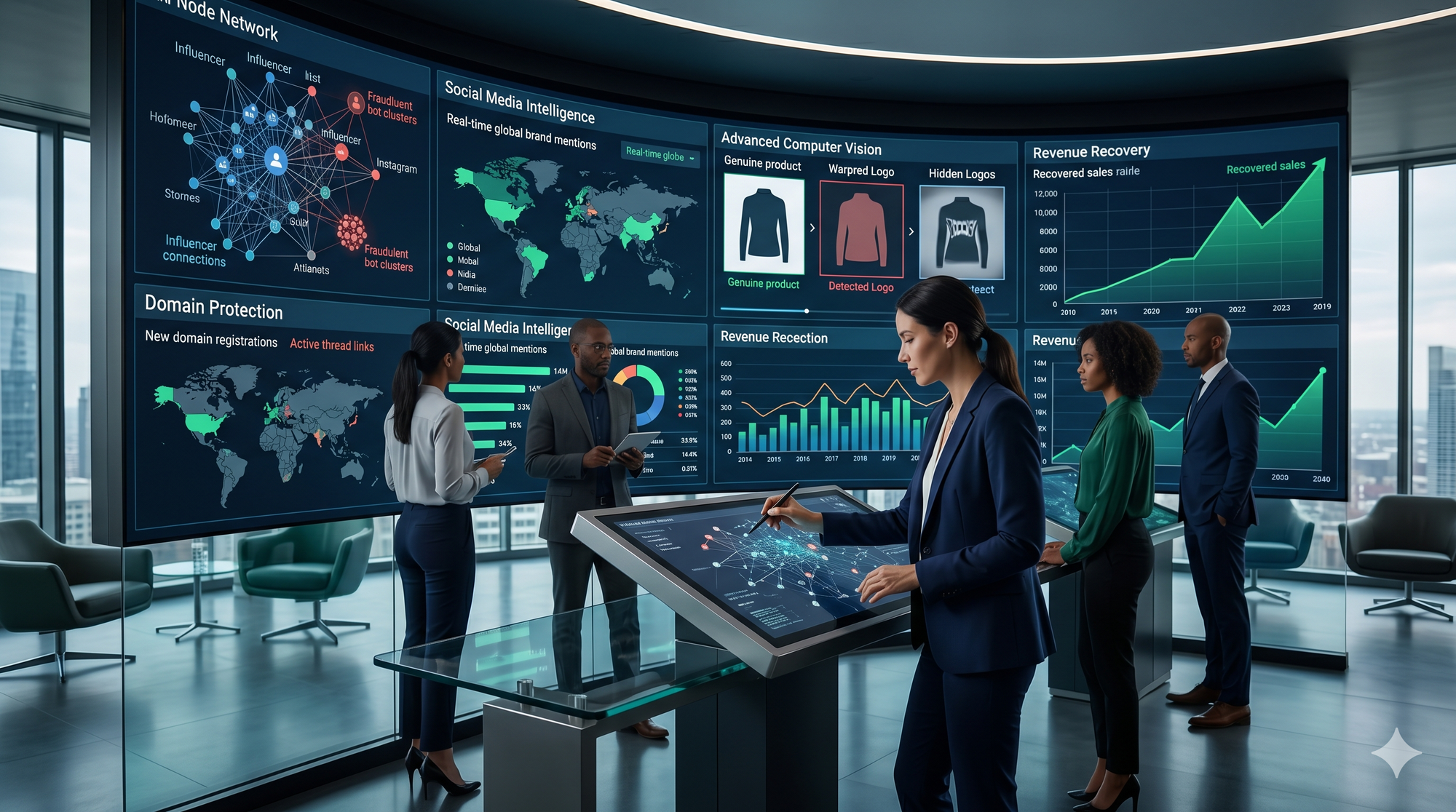
The digital landscape of 2026 has rendered manual brand monitoring obsolete. With counterfeit networks utilizing generative AI to automate fraudulent listings and social media ads, brands face a volume of infringement that exceeds human capacity. This article explores the transition from traditional "notice-and-takedown" workflows to autonomous, AI-driven protection systems. We analyze how Social Media Intelligence & Protection and Domain Protection work in synergy to identify deep-fake storefronts and redirect diverted traffic. By integrating real-time machine learning, enterprises are not just defending their trademarks but actively achieving Revenue Recovery at a scale previously thought impossible. Discover why moving to an intelligence-first model is the only way to secure your brand's digital future.
The Escalation of Digital Deception
As we navigate through 2026, the complexity of online threats has reached a critical tipping point. Counterfeiters have moved beyond simple logo imitation; they are now utilizing high-velocity automation to flood marketplaces and social feeds with deceptive content. Recent data suggests that the annual cost of global counterfeiting has surged, with a projected impact of $2.8 trillion on the global economy this year.
For a B2B SaaS or high-end consumer brand, this isn't just about lost sales—it's about the erosion of the customer journey. When a user interacts with a "shadow brand," thinking it is yours, the trust link is broken. As established in "The Invisible Leak: How Counterfeit Listings Erode Your Brand Value and Revenue", this leakage often happens in the dark corners of the web that manual searches simply cannot reach.
The Limits of Human Oversight
Traditional brand protection agencies often rely on "analyst reviews"—a polite term for human employees manually scrolling through marketplaces. In an era where 1.2 million new domains are registered every month, and social media platforms generate billions of posts daily, a manual approach is like fighting a forest fire with a water pistol. By the time a human identifies a fraudulent site, the counterfeiter has likely already harvested enough data and revenue to shut down and reappear under a new alias, often utilizing "Safeguarding Your Digital Frontier: The Strategic Shift to AI-Powered Domain Protection" vulnerabilities.
Why Traditional Brand Protection Fails Today?
Traditional brand protection fails because it is reactive and linear. Counterfeiters use AI to generate 24/7 "flash" advertisements and spoof domains that bypass static keyword filters. Human-led teams cannot compete with the speed, volume, and cross-platform complexity of modern infringement networks, leading to delayed enforcement and sustained revenue loss.
Designing an Autonomous Defense System
The shift to AI-driven Brand Protection is not a luxury; it is a necessity for survival in a hyper-automated marketplace. Intelligence-led protection platforms like Counterfake don't just "look" for fakes; they understand the DNA of an infringement network.
From Keywords to Computer Vision
Old-school tools look for text strings like "Cheap [Brand Name]." Modern counterfeiters have adapted, often leaving brand names out of the text entirely while featuring the logo prominently in images.
Counterfake’s AI uses Advanced Computer Vision (ACV) to scan millions of images per hour. It identifies:
- Warped or hidden logos: Even when blurred to bypass platform filters.
- Product Silhouette Matching: Recognizing the unique design and packaging of your product without needing a textual reference.
- OCR (Optical Character Recognition): Reading text embedded within images and videos, where traditional search engine crawlers often fail.
The Role of Social Media Intelligence
The battle for brand integrity is increasingly fought on social feeds. With the explosion of "dupe" culture, influencers—both human and AI-generated—direct massive traffic to illicit stores. This decentralized threat requires "The Evolution of Social Commerce: Protecting Your Brand in the Era of Intelligence" to map out the relationship between a viral post and a fraudulent checkout page.
Reclaiming the Bottom Line through Revenue Recovery
The most significant advantage of AI-driven intelligence is the ability to turn a security function into a profit engine. In the past, the success of a brand protection program was measured by the number of takedowns. Today, the only metric that truly matters is Revenue Recovery.
The ROI of Speed
In digital commerce, every hour an infringement stays live represents a measurable financial loss. Statistical models show that a fraudulent listing’s conversion rate is highest in its first 12 hours of existence. By automating the detection-to-enforcement loop, AI reduces this "live time" by over 90%. This speed ensures that demand is redirected back to authorized channels before it is captured by bad actors.
The Financial Multiplier
For every dollar diverted by a counterfeiter, there is a "reputation tax" that can cost a brand up to 3x the original sale value in customer service and churn. Effective "The ROI of Trust: Quantifying Revenue Recovery in Modern Brand Protection" strategies quantify these hidden costs, proving that AI-led enforcement pays for itself by reclaiming lost market share.
How Does Machine Learning Enable Revenue Recovery?
Machine learning enables revenue recovery by prioritizing high-traffic infringers that cause the most significant financial displacement. By analyzing the search ranking and social engagement of various unauthorized listings, the AI focuses enforcement efforts on the "Big Fish," ensuring that the brand’s marketing spend results in legitimate sales rather than feeding illicit networks.
Navigating the Global Complexity
Counterfeiting is rarely a local problem. A threat detected in New York often originates from a server in Eastern Europe or a distribution hub in Southeast Asia. Manual legal teams struggle with this cross-border complexity, often bogged down by jurisdictional paperwork.
As discussed in "The Global Shield: Navigating Cross-Border Intellectual Property Challenges in 2026" , an AI-driven approach provides a "Global Shield." Machine learning models are language-agnostic; they can identify your brand's assets across Cyrillic, Mandarin, or Arabic scripts without needing a local analyst for every region.
Predicting the Next Strike
Perhaps the most revolutionary aspect of current AI models is their predictive capability. By monitoring registration patterns in the Domain Name System (DNS) and tracking "bot-farm" activity on social platforms, Counterfake can identify the preparations for a counterfeit campaign before the first ad even goes live.
- Dormant Domain Monitoring: Detecting thousands of brand-similar domains registered in a single block.
- Infrastructure Correlation: Linking new fraudulent sites to previously banned bad actors through IP and payment gateway fingerprinting.
- Proactive Takedowns: Notifying registrars and platforms of malicious intent before the actual infringement occurs.
The 3 Core Pillars of AI-Led Brand ProtectionAutonomous Discovery: 24/7 scanning across marketplaces, social media, and the web using computer vision.Network Analysis: Identifying the "mastermind" accounts behind thousands of individual listings.Automated Enforcement: Instant filing of DMCA and platform-specific takedowns to minimize the window of lost revenue.
Intelligence as the Ultimate Competitive Advantage
The difference between a brand that thrives and one that struggles in the 2026 digital economy is the ability to control its own narrative. If you allow counterfeiters to own your keywords, mimic your aesthetic, and exploit your customers, you are effectively outsourcing your brand equity to criminals.
Modern Brand Protection is about moving from a defensive, reactive posture to an offensive, intelligence-led strategy. Counterfake provides the tools to clear the digital marketplace of noise, ensuring that when a customer looks for you, they find only you. This is not just about security; it is about reclaiming your right to own your market.
In an era of machine-speed threats, human-speed solutions are no longer enough. The revolution is here, and it is powered by intelligence.
Resources
- World Intellectual Property Organization (WIPO). (2025). Artificial Intelligence and the Enforcement of Intellectual Property Rights.
- OECD/EUIPO. (2026). The Economic Impact of Counterfeiting in the Digital Age: 2026 Update.
- Gartner Research. (2025). The Future of Cybersecurity: Moving from Human-Centric to Autonomous Defense.
- Journal of Business Research. (2026). Consumer Trust and the Impact of Generative AI on Counterfeit Awareness.