Supply Chain Integrity in 2026: Leveraging AI to Control the Gray Market and Protect Global Revenue
Executive Summary
In the complex e-commerce ecosystem of 2026, supply chain integrity has emerged as the frontline of corporate resilience. Brands no longer just face external threats from counterfeiters; they are battling internal leaks, unauthorized "gray market" sellers, and distribution inconsistencies that dilute brand value. Traditional auditing methods are failing to track the sheer volume of global transactions. This article explores how AI brand protection and advanced marketplace monitoring are revolutionizing the way companies regain control over their distribution channels. By moving toward an automated, data-driven approach, organizations can achieve true revenue recovery and secure their digital borders against the sophisticated threats of a fragmented global market.
The Transparency Crisis in Modern Distribution
As global trade becomes increasingly decentralized, maintaining a transparent supply chain has become one of the most significant challenges for enterprise brands. In 2026, the traditional boundaries of geographic distribution have dissolved. A product intended for a specific wholesale partner in one region can appear on a global marketplace at a massive discount in another, often within hours. This phenomenon, known as the "gray market," represents a fundamental threat to online brand protection and pricing stability.
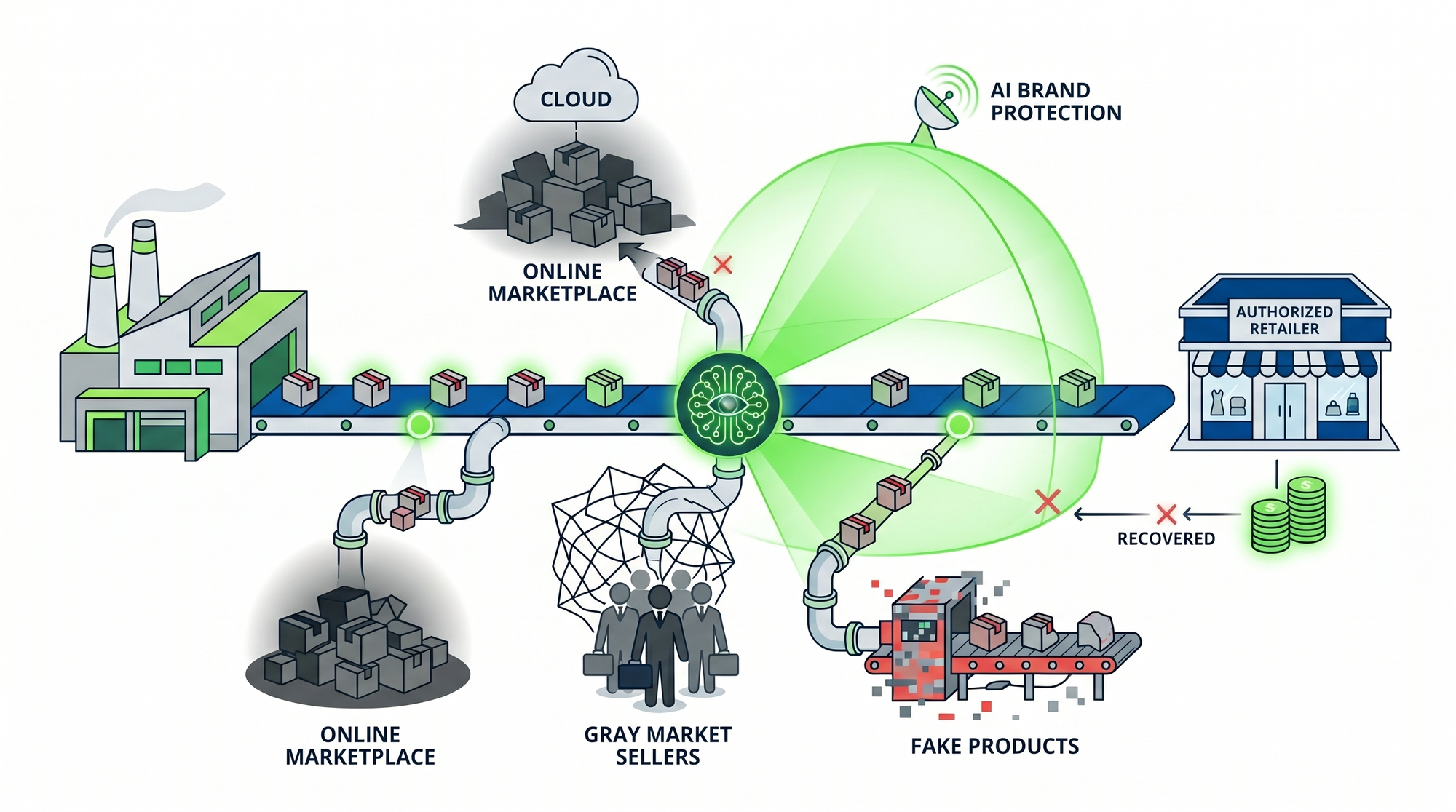
When distribution channels leak, the damage is multi-layered. Unauthorized sellers undercut legitimate partners, causing friction within the authorized dealer network. More importantly, these leaks often serve as a gateway for fake products to blend in with genuine inventory, making counterfeit detection nearly impossible for the average consumer. Without a robust strategy for digital risk protection, brands lose the ability to verify where their products are coming from and who is selling them.
The scale of this issue is fueled by the same technological shifts we examined in our analysis of "Why Fake Products Are Increasing in 2026: The Strategic Shift in Brand Protection". As bad actors utilize AI to find and exploit supply chain vulnerabilities, brands must respond with equal or greater technological sophistication to preserve their supply chain integrity.
What is Supply Chain Integrity?
Supply chain integrity refers to the state of a distribution network where every product is accounted for, authorized for its specific market, and sold by verified partners. It involves using AI brand protection to ensure that goods move from production to the end consumer without being diverted into the gray market or replaced by fake products, thereby securing revenue recovery and brand equity.
The Financial Drain of Unauthorized Sellers
For a long time, companies viewed unauthorized sellers as a minor annoyance rather than a strategic threat. However, in today’s hyper-competitive landscape, the cumulative effect of these "leaks" is a significant drain on the bottom line. Unauthorized sellers do not just steal a single sale; they devalue the entire brand by ignoring MSRP (Manufacturer's Suggested Retail Price) and MAP (Minimum Advertised Price) policies.
This price erosion makes it difficult for authorized retailers to compete, eventually leading to a loss of shelf space and decreased loyalty from high-value partners. Furthermore, when unauthorized sellers dominate a marketplace listing, they hijack the brand's SEO and customer feedback loops. This is a critical component of "Calculating the ROI of Brand Protection: Transforming Enforcement into a Revenue Engine", where we see that reclaiming these diverted sales is the fastest path to positive ROI.
Beyond direct sales loss, the presence of unauthorized sellers complicates counterfeit detection. When a brand allows its supply chain to become "noisy" with unauthorized but genuine goods, it creates a smokescreen that counterfeiters use to hide their fake products. If a brand cannot tell which of its genuine goods are on the market, it certainly cannot identify the fakes with precision.
Why Traditional Supply Chain Audits Are Obsolete
Historically, brands relied on manual audits, serial number tracking, and physical inspections to maintain supply chain integrity. In 2026, these methods are effectively a relic of the past. The speed of digital commerce means that by the time a manual audit is completed, the diverted goods have already been sold and delivered.
The limitations of traditional methods include:
- Reactive Nature: They only find problems after the financial damage is done.
- Lack of Scale: Human teams cannot monitor millions of listings across hundreds of global marketplaces.
- Data Silos: Information from the warehouse, the legal department, and the sales team rarely talks to each other in real-time.
This is why a shift toward AI brand protection is mandatory. Rather than looking at physical boxes, AI looks at digital signals. It monitors price anomalies, seller registration data, and inventory fluctuations across the web to identify a leak at its source before it scales into a global problem.
5 Signs of a Supply Chain LeakPrice Anomalies: Products appearing online at prices lower than wholesale costs.Geographic Mismatches: Region-specific SKUs being sold in unauthorized territories.Seller Anonymity: High-volume sellers with no verifiable link to authorized distributors.Sudden Inventory Surges: Large quantities of a specific product appearing on niche marketplaces simultaneously.Packaging Discrepancies: Genuine products sold without original warranties or in non-standard packaging.
The AI Solution: Real-Time Marketplace Monitoring
To regain control, brands are turning to advanced marketplace monitoring tools that act as a digital immune system. These platforms utilize machine learning to scan the global e-commerce landscape 24/7, identifying unauthorized activity with a level of precision that was previously impossible.
Modern digital risk protection platforms, like Counterfake, go beyond simple keyword alerts. They analyze seller behavior patterns. For instance, if a seller in Eastern Europe suddenly lists 5,000 units of a product intended for the North American market, the AI flags this as a distribution breach. By integrating this data with counterfeit detection algorithms, brands can distinguish between a gray market leak and a genuine counterfeit threat.
As we discussed in "Marketplace Monitoring: How AI Redefines Brand Integrity Across Global Channels", the goal of monitoring is no longer just to "find" a problem—it is to provide actionable intelligence that leads directly to revenue recovery.
Integrating Social Radar for Distribution Control
In 2026, supply chain leaks aren't just happening on Amazon or Alibaba. They are happening on social media. "Hidden links" in Instagram bios and private Telegram groups have become the primary channels for moving diverted inventory. This is where Counterfake’s specialized Social Media Intelligence & Protection becomes indispensable.
Unauthorized distributors often use social platforms to create "exclusive" groups where they move goods at a discount. These platforms offer a level of anonymity and speed that traditional web crawlers miss. By utilizing AI-driven social listening and visual recognition, Counterfake identifies when your brand’s products are being showcased in these unauthorized social circles. This ensures that your online brand protection strategy covers the "dark social" corners of the internet where traditional supply chain integrity tools fail.
The Path to Proactive Revenue Recovery
The ultimate goal of securing the supply chain is to transform the brand protection department into a profit-protection center. Every unauthorized listing removed is a customer redirected to an authorized, full-margin channel.
Transitioning to this model requires a move from reactive defense to proactive intelligence. In our MOFU exploration of "AI Brand Protection: Moving from Reactive Defense to Proactive Revenue Recovery", we detailed how this shift allows brands to reclaim market share that was previously considered "lost" to the gray market. By treating supply chain leaks as a data problem, brands can identify the specific "holes" in their distributor agreements and tighten their physical logistics accordingly.
How AI Strengthens Supply Chain Integrity
AI-driven platforms strengthen supply chain integrity by automatically cross-referencing online seller data with authorized distributor lists. By identifying price undercutting and unauthorized regional sales, AI facilitates revenue recovery and provides the evidence needed to take legal action against distribution leaks and fake products.
Redefining Brand Governance for the Future
The challenge of supply chain integrity is not going away. As global markets continue to fragment and social commerce grows, the pressure on distribution channels will only increase. Brands that continue to rely on manual audits and siloed data will find their margins perpetually squeezed by unauthorized sellers and counterfeiters.
The organizations that will thrive in 2026 are those that embrace online brand protection as an integrated, AI-first discipline. By leveraging marketplace monitoring to oversee the entire lifecycle of a product—from the factory floor to the digital storefront—companies can ensure that their innovation is rewarded and their reputation remains untarnished.
The fight for your brand’s revenue is won or lost in the visibility of your supply chain. It is time to stop guessing where your products are going and start using the intelligence needed to keep them in authorized hands.
Secure your distribution channels and reclaim your market share. Discover how Counterfake’s AI-driven platform can restore your supply chain integrity today.
REFERENCES
- OECD (2024): The Economic Impact of Counterfeiting and the Gray Market in Global Trade.
- McKinsey & Company (2026): Next-Generation Supply Chain: Building Resilience through AI and Transparency.
- EUIPO (2025): Intellectual Property Rights and the Evolution of Unauthorized Distribution Channels.
- Statista (2026): Global E-commerce Loss and Gray Market Proliferation Forecast.
- Industry Report (2026): The Role of Automated Marketplace Monitoring in Modern Brand Governance.