Mastering E-Commerce Product Classification: Using AI to Stop Category Fraud
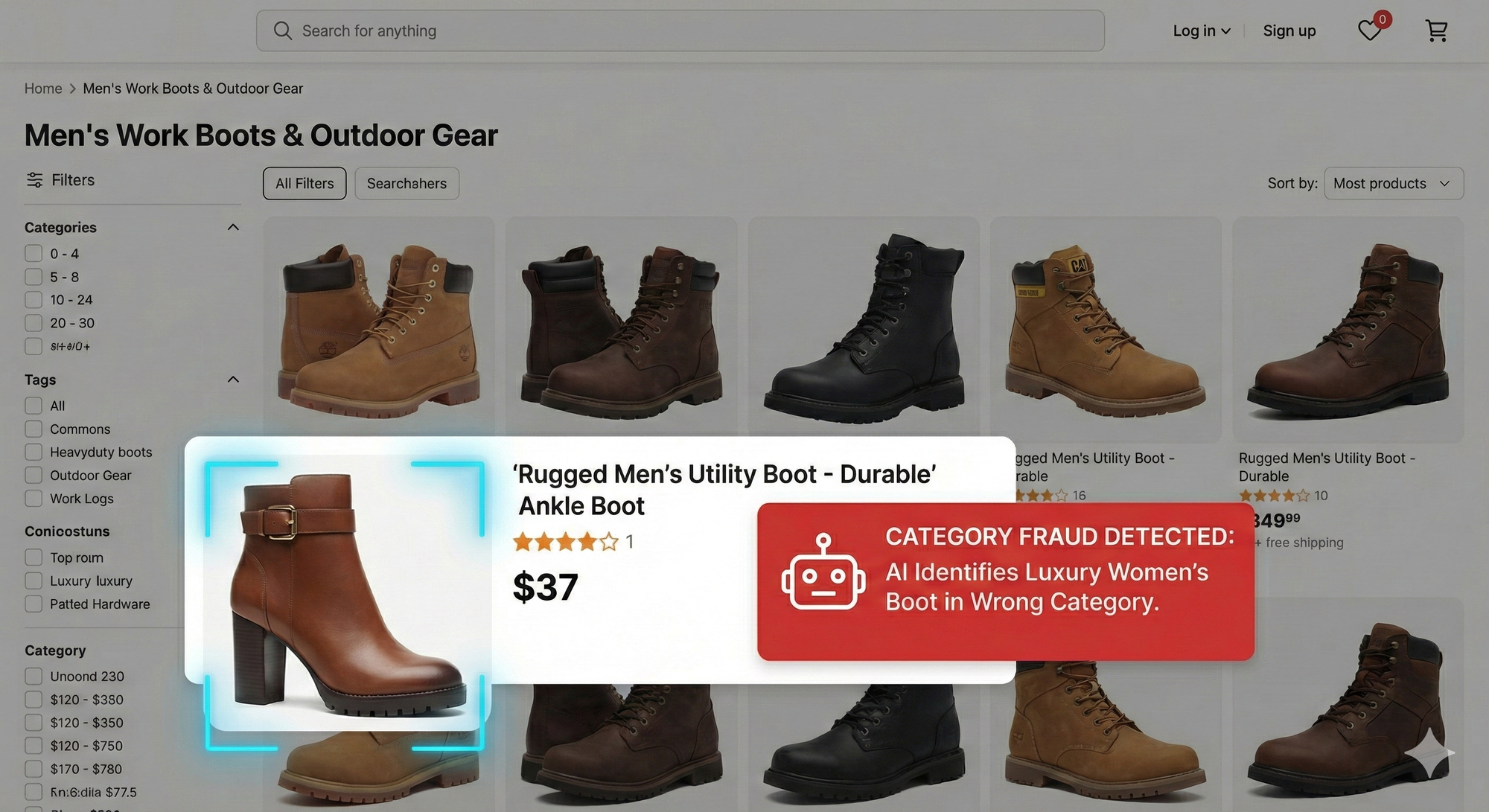
Executive Summary Category Fraud is the "Trojan Horse" of 2026 e-commerce. By misclassifying luxury goods under generic or unrelated categories (e.g., listing a designer watch as a "Handmade Bracelet" or a high-end stiletto as a "Men's Work Boot"), counterfeiters successfully evade brand-specific filters and keyword-based takedown tools. Mastering product classification through multi-agent AI is no longer optional; it is the frontline of digital brand defense.
--
The sheer volume of listings on global marketplaces makes manual oversight an impossible task. Counterfeiters have learned that if they list a "Rolex" under "Kitchen Hardware," the brand’s automated protection tools—which are likely scanning the "Jewelry" category—will never find it. However, the threat has evolved beyond obvious category jumps; today's "Superfakes" utilize subtle deviations to stay hidden.
The Economics of Misclassification: The Profit Margin Gap Counterfeiters exploit the "Gray Areas" of marketplace taxonomies not just for invisibility, but for financial gain. Every e-commerce category carries different commission rates, insurance requirements, and profit margins.
The Hidden Cost: When a luxury item is misclassified into a lower-tier category the platform’s higher commission structure for luxury goods is bypassed. For the brand, this leads to revenue leakage and distorted market valuation. Counterfeiters use these "Margin Gaps" to fund faster production cycles, while legitimate brands are left with polluted data and lost sales. In 2026, a 2% difference in category commission can translate into millions in lost revenue for a global brand.
Micro-Detection: Finding the Invisible Needle At Counterfake, we’ve moved beyond detecting "bags in gardening tools." Our AI now identifies even the most subtle misclassifications that humans and standard filters overlook:
- The Gender/Style Pivot: A counterfeit luxury women’s heel listed as a "Men's Rugged Boot" to bypass gender-specific pricing algorithms and gender-targeted brand filters.
- Functionality Masking: A sophisticated smartwatch listed as a "Minimalist Decorative Bracelet" to avoid the strict technical certifications and taxes required for high-end electronics.
Main Visual: Detecting the Micro-Deviation One line explanation: I am generating an image showing a luxury watch being identified as a "Fashion Bracelet" by AI to highlight subtle category fraud.
Data Visual: The Category Profit Gap One line explanation: I am generating an infographic showing how different categories have different commission rates and how counterfeiters exploit this margin gap.
The Solution: Contextual Image Recognition True brand protection requires a system that refuses to trust the text. Counterfake’s AI doesn't just look at the category tag; it analyzes the visual context and the seller's entire ecosystem. By utilizing microscopic texture and proportion analysis, the AI compares the pixels of the listing to the brand's official "Digital Twin." If a "Fashion Accessory" listing contains the visual signature and mechanical complexity of a luxury watch, the system flags it immediately.
Trusting Pixels Over Labels The future of e-commerce security lies in the ability to see past the merchant's description. In 2026, effective brand protection requires contextual image recognition that can distinguish a stiletto from a boot even when the metadata says otherwise. By refusing to trust the label and instead trusting the pixels, brands can shut down the hidden avenues where fraud currently flourishes. This transition from keyword-based filtering to visual logic is what ultimately separates protected brands from olan those left vulnerable to the "Trojan Horse" of misclassification.
References:
- OECD/EUIPO – Misclassification Trends in the Global Trade of Fake Goods (2026 Report)
- World Intellectual Property Organization (WIPO) – Strategic IP Management in Digital Marketplaces
- Forbes – The Hidden Costs of E-Commerce Category Fraud on Brand Valuation