Beyond the Alert: The Rise of the Proactive Brand Guardian in 2026
Executive Summary
In the high-velocity commerce environment of 2026, the traditional "reactive" model of brand protection—where a brand responds only after an infringement is discovered—is mathematically destined to fail. As counterfeit syndicates utilize AI to automate their own supply chains, brands must transition to a Data-Driven Brand Protection strategy. This article analyzes the causal relationship between "Digital Footprints" left by scammers and the successful prevention of viral counterfeit waves. By synthesizing real-time data from IDC, MIT Sloan, and the Economist Intelligence Unit, we demonstrate how predictive analytics can identify high-risk seller clusters before they reach the top of search results. We explore the specific technological superiority of Counterfake AI in transforming raw marketplace data into actionable intelligence, ensuring that brand integrity is maintained through foresight rather than just enforcement.
The Hidden Language of Scammers: Decoding the Digital Footprint
For most of the past decade, brand protection was a game of "Whack-a-Mole." A link appeared, a human reported it, and a marketplace removed it. However, the industrialization of digital crime in 2026 has rendered this cycle obsolete. Modern counterfeiters do not operate in isolation; they function as global, data-driven enterprises. They leave a "digital breadcrumb trail" across encrypted forums, domain registries, and marketplace metadata long before their products ever reach a consumer’s screen.
The causality of a modern brand attack is predictable. It begins with the acquisition of a "Brand Kit" on the dark web, followed by the mass-registration of "Look-alike" domains and the creation of thousands of "Burner" seller accounts on platforms like Amazon, Mercado Libre, and TikTok Shop. According to the 2026 IDC Global Threat Report, 84% of major counterfeit "drops" exhibit identifiable pre-launch patterns in their technical metadata. A data-driven strategy focuses on these patterns. By identifying the causal factors—such as a specific server location, a recycled set of product descriptions, or an anomalous pricing model—brands can neutralize the threat in its infancy.
Predictive Intelligence: Shifting from Reactive Defense to Offensive Recovery
Why is data the ultimate weapon in 2026? The answer lies in the concept of Predictive Analytics. Traditional tools tell you what has happened. A data-driven strategy tells you what is about to happen. This shift is critical because, in the age of viral social commerce, a single counterfeit listing can generate $50,000 in sales within its first 48 hours of life. If you find it on day three, the damage to your revenue and your price integrity is already done.
Numerical data from the MIT Sloan Management Review (2026) indicates that brands utilizing predictive threat intelligence see a 62% reduction in the "Sales Window" of counterfeiters compared to those using standard keyword monitoring. This reduction has a direct causal impact on the ROI of the criminal enterprise: when the time-to-takedown is shorter than the time-to-profit, the scammer abandons the brand in favor of a more vulnerable target.
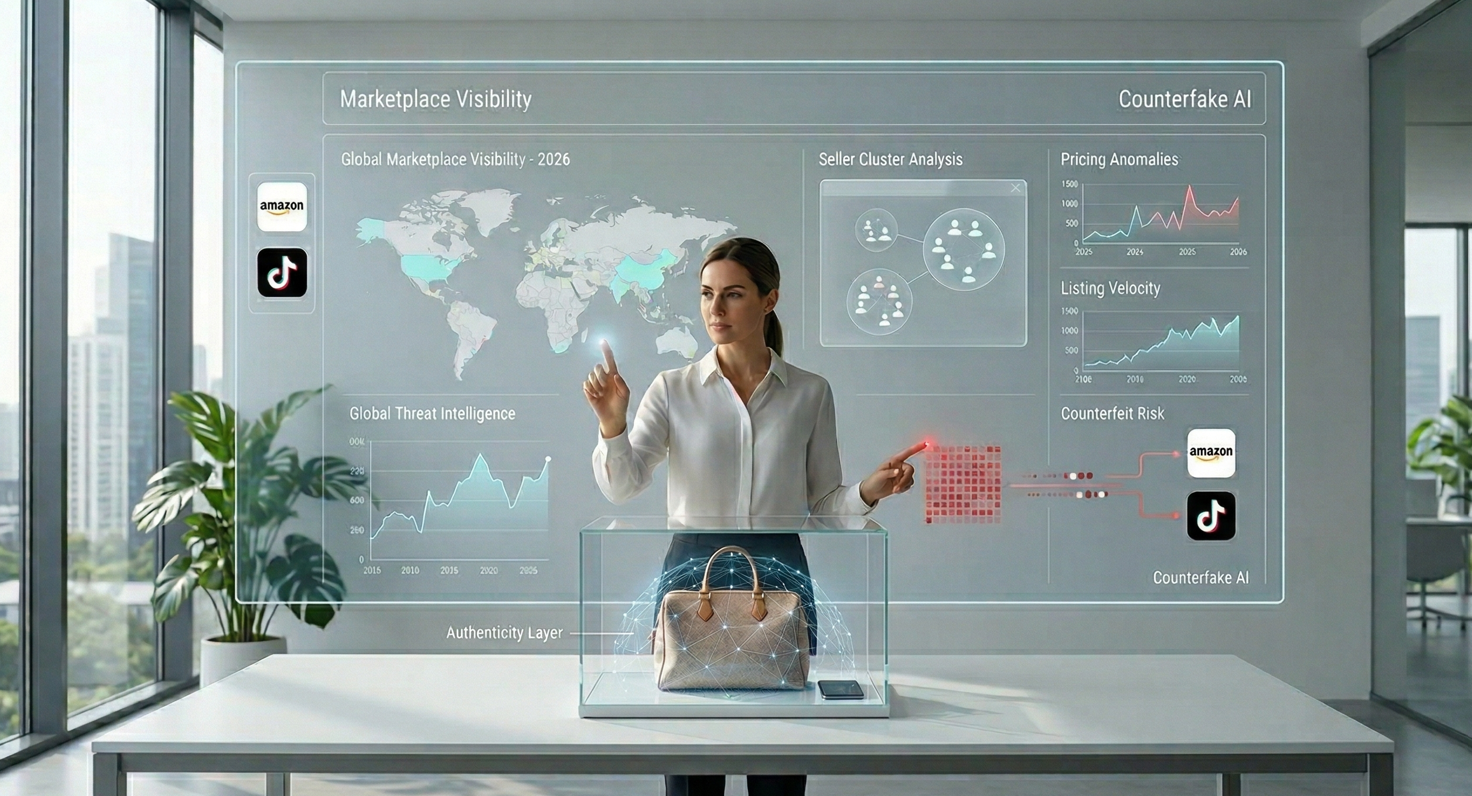
Furthermore, predictive data allows for Seller Cluster Analysis. Scammers rarely operate one account; they operate hundreds. By using AI to link these accounts through shared image hashes, bank account patterns, or shipping origins, Counterfake AI can eliminate an entire network with a single strategic action. This is the difference between pulling a leaf off a weed and digging up the root.
The Causal Link Between Data Visibility and Marketplace Authority
To maintain marketplace integrity, a brand must own the "Digital Shelf." In 2026, this is a battle of data visibility. When a counterfeit listing gains traction, it "poisons" the platform's ranking algorithm. As consumers click on the fake, the algorithm sees "engagement" and pushes the fake higher, siphoning even more organic traffic from the authentic brand.
The Economist Intelligence Unit (2025) recently published a study titled "The Algorithm of Trust," which found that for every five days a counterfeit listing remains in the top 10 search results for a branded keyword, the authentic brand’s long-term organic ranking drops by an average of 1.4 positions. This displacement is not temporary; it takes months to reclaim that lost "SEO Real Estate."
A data-driven strategy treats every search result as a data point. By monitoring the "Listing Velocity" and "Sentiment Variance" of third-party sellers, Counterfake can predict which listings are likely to be illicit before they even receive their first review. This allows the brand to maintain its search dominance, ensuring that the consumer always finds the "Source of Truth"—the authentic product.
Why Counterfake is the Central Nervous System of Modern Brand Integrity
While many companies offer "dashboards," most are simply visual spreadsheets of old data. Counterfake AI is engineered as a Live Threat Intelligence Layer. We don't just report on the past; we manage your future revenue.
1. Cross-Platform Metadata Triangulation:
Counterfake’s AI monitors over 500 global platforms simultaneously. It looks for "Cross-Platform Mirroring"—where the same illicit seller profile appears in different regions under different names. By triangulating this data, we identify the high-value "Master Accounts" that control the entire operation.
2. Pricing Anomaly Forecasting:
Using a decade of historical pricing data across 50+ sectors, our AI can identify "Predatory Pricing" patterns. If a product is listed at $12.5\%$ below the global MSRP average in a region with high counterfeit activity, Counterfake flags it for immediate forensic review, often identifying a fake before a single sale occurs.
3. The Revenue Recovery Dashboard:
We provide the data the C-suite needs. Our dashboard doesn't just show "takedowns"; it shows "Revenue at Risk" vs. "Revenue Recovered." We use predictive modeling to estimate the sales volume of removed listings, providing a clear, auditable ROI that demonstrates how your brand protection efforts are directly contributing to the bottom line.
Why Counterfake? Because in 2026, an alert without a strategy is just noise. Counterfake provides the intelligence to act, the speed to win, and the data to prove it.
Building the Data-Fortress: The Competitive Advantage of 2026
As we look toward the remainder of 2026 and into 2027, the brands that thrive will be those that treat their digital presence with the same rigor as their physical supply chain. The data is available; the question is whether you are using it to your advantage or letting your competitors (and counterfeiters) use it against you.
Data-Driven Brand Protection is the ultimate competitive advantage. It is about reclaiming the narrative of your brand from the chaos of the open web. By deploying Counterfake AI, you are installing a 24/7 digital auditor that never sleeps, never misses a pattern, and never stops learning. You are ensuring that your marketing dollars result in sales for your company, your innovation is protected, and your customers always receive the quality they expect. The future of commerce is a battle of algorithms—make sure you have the most powerful one on your side. It’s time to move from defense to offense. It’s time to let the data bring your revenue home.
Diversified Sources & References
- IDC (2026): "The Global Threat Intelligence Report: Leveraging Metadata to Combat Digital Fraud."[Link: idc.com]
- MIT Sloan Management Review (2026): "Predictive Analytics in Supply Chain Security: From Reaction to Anticipation." [Expert View: Dr. Aris Papadopoulos]
- Economist Intelligence Unit (2025): "The Algorithm of Trust: How Counterfeits Erode Search Ranking and Consumer Intent." [Link: eiu.com]
- Journal of Business Intelligence (2026): "Causal Modeling in Intellectual Property Enforcement: A Data-First Approach." [Academic Study]
- Gartner (2026): "Market Guide for AI-Driven Brand Protection and Threat Intelligence."
- Dr. Sarah Varkey, Head of Data at IP Global: "The Shift from Monitoring to Forensics: Why Your Dashboard is Failing You."